Most people go looking for their dog’s lymph nodes for one reason: they felt something under the jaw, and now they cannot stop thinking about it.
Dogs have five sets of lymph nodes you can check yourself. They come in pairs, and in a healthy dog, most of them are small enough that finding them takes practice. Learning what normal feels like on your own dog, while she is well, is the single most valuable thing this article can give you.
In this article, we’ll talk about where each set is, what normal feels like, what should prompt a phone call, and why a swollen node is very often not cancer.
This article is general education, not veterinary advice. Home palpation does not replace a physical exam. If you find a lump you are unsure about, call your veterinarian rather than watching it.

What Lymph Nodes Do
Think of the lymphatic system as a second circulatory system, running alongside the blood vessels. Instead of blood, it carries lymph, a clear fluid that collects out of tissue, and instead of a heart, it relies on movement and muscle to push that fluid along.
Lymph nodes are the filter stations. Fluid draining from a region of the body passes through the nodes assigned to that region, where immune cells inspect it for bacteria, viruses, and abnormal cells. When something is found, the node swells with the immune cells recruited to deal with it.
This is why a swollen node is information rather than a diagnosis. It tells you the node is busy. The whole job of a veterinary workup is finding out why.
It is also why one particular pattern matters so much. A node swelling on one side, near a wound or an infected tooth, usually means the node is doing its job locally. Every node in the body swelling at once means something systemic.
Dog Lymph Node Location Chart
There are five sets of lymph nodes. All paired, left and right. Work through them in the same order every time, and you will build a memory of what normal for your dog feels like.
Mandibular, under the jaw
Also called submandibular. They sit beneath the jaw, on either side of the windpipe, just where the jaw meets the neck. These are the ones the owners are most likely to find, and the ones veterinary teaching texts describe as most reliably palpable in a normal dog. There are usually two to four nodes on each side.
Prescapular, in front of the shoulder
Properly called the superficial cervical nodes. They lie just in front of the shoulder joint, where the neck runs into the shoulder, tucked under the superficial neck muscles. They are easiest to find with your dog standing. Press gently in front of the point of the shoulder and deepen the pressure slowly.
Popliteal, behind the knee
On the back of the hind leg, directly behind the stifle, which is the dog’s knee. In most dogs, these feel like a small firm bead sitting in the soft hollow between two muscles. After the mandibular nodes, these are usually the easiest to locate.
Axillary, the armpit
In the armpit, at about the level of the shoulder joint, where the front leg meets the chest. Most dogs have a single node on each side. In a healthy dog, you generally cannot feel it at all. If you can feel it clearly, that is worth mentioning to your vet.
Inguinal, the groin
In the groin, along the inner thigh on either side. Like the axillary nodes, these are usually not palpable unless enlarged, and they are harder to find in overweight dogs.
| Node | Where to feel | Feelable when healthy? | Comes in |
|---|---|---|---|
| Mandibular | Under the jaw, beside the windpipe | Usually yes | Pairs |
| Prescapular | In front of the shoulder joint | Often yes | Pairs |
| Popliteal | Behind the knee, hind leg | Usually yes | Pairs |
| Axillary | The armpit, at the shoulder joint | Usually not | Pairs |
| Inguinal | The groin, inner thigh | Usually not | Pairs |
Dogs also have many internal lymph nodes, including the retropharyngeal nodes deep in the throat and nodes throughout the chest and abdomen. These cannot be felt from outside and are assessed with imaging.
| The lump under the jaw is sometimes not a lymph node at all
The mandibular salivary gland sits in almost the same place. It is normally larger than the lymph node, it lies a little further back and higher, and it is less mobile under your fingers. Owners mistake it for a swollen node constantly. So do some clinicians on a quick exam. This is one more reason to have a vet confirm what you have found. |
What a Normal Lymph Node Feels Like
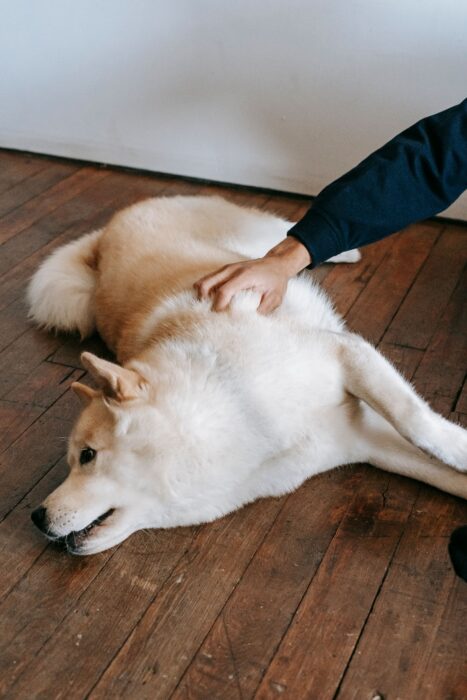
Small, soft to slightly firm, smooth, and mobile. It should slide a little under the skin when you roll a finger over it. Your dog should not react.
Size varies with the size of the dog, and precise measurements are less useful than comparison. In a medium dog, the popliteal node is often described as pea-sized. The mandibular nodes are usually a bit larger. What matters is not the number; it is whether this node feels different from its partner on the other side, and whether it feels different from last month.
How to Check Your Dog’s Lymph Nodes at Home
- Pick a calm moment. After a walk, while your dog is relaxed and standing or lying on her side. Not when she is excited or sore.
- Use flat fingers, not fingertips. Press gently with the pads of two or three fingers and move in small circles. Digging with a fingertip finds nothing and annoys the dog.
- Always compare left to right. Feel one side, then the matching side. Asymmetry is more meaningful than size.
- Go in the same order every time. Jaw, shoulders, armpits, groin, behind the knees. A routine builds a baseline.
- Do it monthly, when your dog is well. The point is to learn what normal is like. You cannot recognize a change if you have nothing to compare it to.
If your dog objects, stop. This is meant to be a scratch that happens to be useful, not an examination she learns to dread.

When a Swollen Node Means Something
Swollen lymph nodes have a long list of causes, and most of them are not cancer. Infections, tick-borne disease, dental disease, skin allergies, wounds, immune disease, and vaccination reactions can all enlarge the nodes. A single swollen node near an obvious problem, an abscessed tooth, an infected paw, usually reflects that problem.
Two patterns deserve a same-week phone call.
- All of them at once. Multiple node sets enlarged simultaneously, in a dog who otherwise seems fine, is the classic presentation of multicentric lymphoma.
- Firm, painless, and growing. Reference texts describe lymphoma nodes swelling to three to ten times normal size while remaining painless. Infected nodes tend to hurt. Lymphoma nodes tend not to.
A node that is hot, painful, or oozing needs seeing quickly too, though that picture points more toward infection than cancer.
Here’s something to keep in mind, because it may come up. To find out what’s going on inside a swollen node, the vet takes a small sample with a needle. You might expect them to sample the obvious lump under the jaw, but they often won’t. The nodes under the jaw sit right next to the mouth, where they’re always fighting off everyday mouth bacteria, so a sample from there can look alarming even when nothing serious is wrong. To get a clearer answer, vets usually prefer to sample a node farther from the mouth, like the one behind the knee or in front of the shoulder. So if your vet skips the lump you’re worried about and takes a sample somewhere else, that’s the reason.
Frequently Asked Questions
Where are a dog’s lymph nodes located?
Five sets can be felt from outside: under the jaw (mandibular), in front of the shoulders (prescapular), in the armpits (axillary), in the groin (inguinal), and behind the knees (popliteal). All come in pairs. Many more lie inside the chest and abdomen and cannot be felt.
Do dogs have lymph nodes in their neck?
Yes. The mandibular nodes sit under the jaw where it meets the neck, and the prescapular nodes sit lower, in front of the shoulder. What owners often call a gland in the neck is one of these, or sometimes the mandibular salivary gland, which sits nearby and is easily confused with a node.
What size should a dog’s lymph nodes be?
Small enough that finding them takes a little effort. In a medium dog the popliteal node is roughly pea-sized. Size varies with breed and body size, so the useful comparison is left against right, and today against last month.
Which lymph nodes can you actually feel on a healthy dog?
Usually the mandibular, prescapular, and popliteal. The axillary and inguinal nodes are typically not palpable unless they are enlarged.
Does a swollen lymph node mean cancer?
No. Infection, dental disease, allergies, and immune conditions all cause swelling, and a single enlarged node near a wound usually reflects local trouble. Several enlarged nodes at once, firm and painless, in a dog who seems well, is the pattern that most often turns out to be lymphoma. Either way, it needs a veterinarian.
Sources
The information in this article was drawn from the following veterinary sources. Each link goes to the original publication.
University of Guelph: Peripheral Lymph Nodes, clinical skills text. Which nodes are palpable in the normal dog, and palpation technique.
Today’s Veterinary Practice: Surgical Anatomy of Peripheral Lymph Nodes. Node locations, node counts, and distinguishing the mandibular salivary gland.
VIN and WSAVA: Cytological Evaluation of Canine and Feline Lymph Nodes. Which nodes to sample and why mandibular nodes can mislead.
Merck Veterinary Manual: Malignant Lymphoma in Dogs. Node enlargement in lymphoma.
The Bottom Line
Five sets, all paired: under the jaw, in front of the shoulders, in the armpits, in the groin, behind the knees. In a healthy dog you should be able to find the first, second, and last of those, and probably not the other two.
Normal means small, smooth, mobile, painless, and matched on both sides. Learn that on your own dog while she is well, once a month, in the same order, with flat fingers. It takes two minutes.
Then, if you ever find something firm and painless on both sides that was not there before, you will know it early, and you will know it matters. That is the whole reason to bother.
About This Article
Published by Tucson Vetcalls, Dr. Maria Miller’s in-home veterinary practice serving Tucson and Southern Arizona, providing end-of-life care in families’ homes since 2000.
If you have found a lump, the right next call is to your primary veterinarian, who can aspirate it and tell you what it is. We publish this because owners who know what normal feels like tend to catch things sooner, and sooner is almost always better.