Nobody wants to be the person asking what it costs. Ask anyway. The number changes what is possible, and pretending otherwise helps neither you nor your dog.
The honest headline: a full course of chemotherapy for canine lymphoma usually runs somewhere between three and ten thousand dollars in the United States. Prednisone alone costs about the same as a streaming subscription. Between those two extremes sit several legitimate options that most owners are never told about.
Prices in this article are typical United States ranges compiled from veterinary hospitals and industry surveys, and they are estimates. Costs vary by region, by practice, and with your dog’s body weight, since chemotherapy is dosed by size. Only your veterinarian can quote your dog.
The Short Answer

A 2025 survey of veterinary costs across all fifty states, conducted for CareCredit, put the national average cost of treating a dog diagnosed with lymphoma at $5,254. Individual quotes commonly range from about $3,000 to $10,000 for a full multidrug protocol.
Notice how much of that chart is empty on the left. The gap between prednisone alone and full CHOP is not a gap in caring. It is a gap in what medicine can buy, and there are real options inside it.
What Drives the Price
- Your dog’s weight. Chemotherapy is dosed by body size. Treating a great dane costs substantially more than treating a beagle, for the same protocol.
- How many doses. A full CHOP course runs roughly 19 to 25 weeks. Each visit carries a drug cost, an administration fee, and bloodwork.
- Who treats her. Board-certified oncologists at specialty hospitals charge more than general practices. They also see more lymphoma.
- Where you live. Regional variation is large, and quotes from two practices twenty miles apart can differ by thousands.
- Whether it relapses. Most dogs eventually do. Rescue protocols are a second bill, not a continuation of the first.
The Costs Before Treatment Even Starts

The diagnosis and staging happen first, and they are billed separately. Budget for them.
| Item | Typical range | Is it necessary? |
|---|---|---|
|
Oncologist consultation |
$125 to $250 | Worth it. Some general vets manage lymphoma well |
|
Fine needle aspirate and cytology |
$100 to $300 |
Yes. This is the diagnosis |
|
Immunophenotyping, B-cell or T-cell |
$200 to $400 |
Strongly advised. It changes the outlook and the plan |
|
Bloodwork and chemistry panel |
$100 to $200 |
Yes, and repeated before each chemotherapy dose |
|
Chest x-rays |
$150 to $350 |
Usually. Finds disease in the chest |
|
Abdominal ultrasound |
$300 to $600 |
Often. Stages liver and spleen |
| Biopsy, if cytology is unclear | $200 to $500 |
Sometimes. Identifies indolent subtypes |
Ranges compiled from veterinary cost surveys and teaching hospital price lists. Full staging is not always performed, and your vet may reasonably skip some of it.
Diagnostics commonly add $500 to $1,500 before a single drug is given. If money is tight, tell your veterinarian at this point rather than later. The aspirate and the immunophenotype are the two that most change decisions.
CHOP, the Standard Protocol
Individual chemotherapy sessions typically run somewhere between $150 and $700 depending on the drug, the dog’s size, and the practice. Doxorubicin days cost more than vincristine days. Bloodwork before each dose adds up.
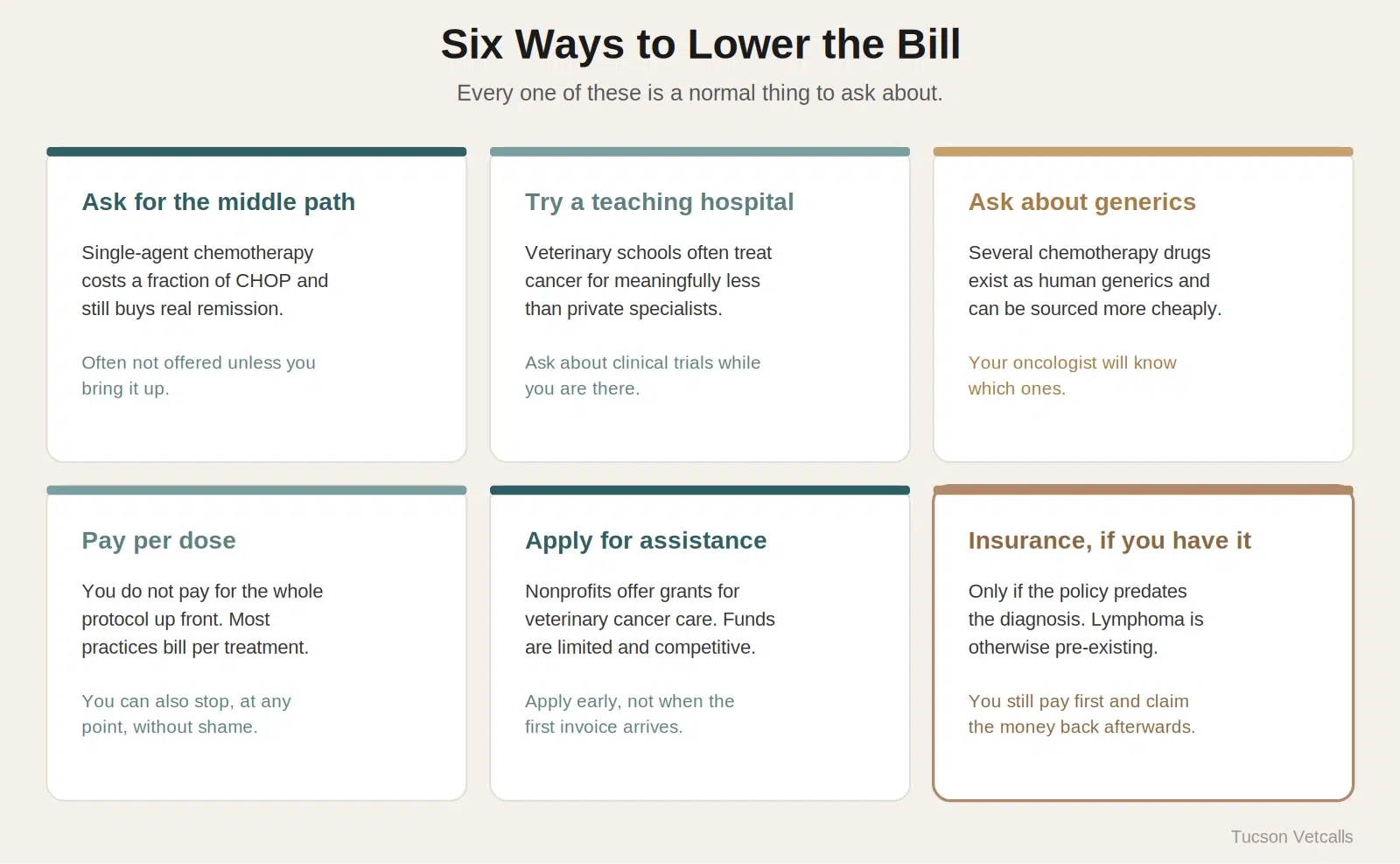
Across a full course, expect roughly $3,000 to $10,000, with the national average landing near $5,254. You do not pay it all at once. Practices bill per treatment or per month, and you can stop at any point, for any reason, including that you have run out of money. Nobody will think less of you.
The Cheaper Options That Actually Work
Single-agent chemotherapy
One drug rather than four, usually doxorubicin or lomustine, often with prednisone. Roughly $1,000 to $3,000 for a course. Remissions are shorter than with CHOP, but they are genuine remissions, and the dog usually feels well during them. This is the option owners most often are not offered, and most often would take if they were.
Prednisone alone
About $20 to $30 a month. It restores appetite and energy for a while and makes many dogs feel noticeably better.
Understand what you are buying. In a prospective trial of 109 dogs treated with prednisone alone, median survival was 50 days. It is comfort care, not cancer control. It is also a completely legitimate choice, and for some families it is the right one.
If it comes back
Rescue protocols are a fresh cost. As an example of real pricing, NC State’s veterinary hospital quotes roughly $2,000 for the first two treatments of one rescue combination and $600 to $700 per treatment thereafter, with other single-drug rescue options around $550 to $700 per treatment.
Pet Insurance: The Timing Problem
Insurance is the single largest cost reducer, and it is almost always too late.
Policies exclude pre-existing conditions. If your dog was diagnosed before the policy started, lymphoma will not be covered. If the policy predates the diagnosis, comprehensive plans commonly reimburse a large share of oncology costs after the deductible. Note the mechanics: you pay the hospital first and claim the money back afterwards, so you still need the cash on the day.
| If you are reading this before a diagnosis
This is the moment insurance is worth buying. Not after the lump appears. Cancer treatment is among the highest-value claims most policies ever pay, and lymphoma is common enough that the odds are not remote, particularly in a boxer, rottweiler, doberman, or an American golden retriever. |
Financial Assistance
Several nonprofits provide grants toward veterinary cancer care, including The Pet Fund, the Brown Dog Foundation, and RedRover. Funding is limited and competitive, so apply early rather than when the first invoice lands. Oncology practices often keep lists of assistance organizations specific to your area, and some maintain their own hardship funds.
- Veterinary teaching hospitals frequently treat cancer for meaningfully less than private specialty practices, through resident training programs.
- Clinical trials can cover much or all of a treatment’s cost. Ask your oncologist what is enrolling.
- Human generics exist for several chemotherapy drugs. Ask whether any of your dog’s protocol can be sourced that way.
- Financing through CareCredit or Scratchpay spreads the bill, often with an interest-free window. Read the terms after the window closes.
Getting an Estimate You Can Trust
- What is the total cost of the full protocol, not the cost per visit?
- Does that figure include the bloodwork before each dose, and the rechecks?
- What happens to the cost if she relapses partway through?
- Is there a single-agent option, and what would it cost?
- Are any drugs in this protocol available as human generics?
- Is there a teaching hospital or clinical trial within driving distance?
Ask all of it in the first appointment. Veterinary oncologists have this conversation daily and are not offended by it.
Frequently Asked Questions
How much does lymphoma treatment cost for a dog?
A full multidrug chemotherapy course typically costs $3,000 to $10,000 in the United States, with a 2025 national survey putting the average for lymphoma at $5,254. Diagnostics add roughly $500 to $1,500 beforehand.
How much does chemotherapy cost per session?
Roughly $150 to $700 per treatment, depending on the drug, your dog’s weight, and the practice. Bloodwork before each dose is usually extra.
What is the cheapest way to treat canine lymphoma?
Prednisone alone, at about $20 to $30 a month. It is palliative, with a median survival of 50 days in a prospective trial. Single-agent chemotherapy, at roughly $1,000 to $3,000, is the least expensive option that still produces real remission.
Does pet insurance cover lymphoma treatment?
Only if the policy was in force before the diagnosis. Lymphoma diagnosed first is a pre-existing condition and will be excluded. When it is covered, comprehensive plans reimburse a substantial share, though you pay the hospital up front and claim afterwards.
Is chemotherapy worth the cost for a dog?
That is a values question, not a veterinary one. What the money buys is remission in 80 to 90 percent of dogs and a median of roughly a year for B-cell disease, during which most dogs feel well. What it does not buy is a cure. Both facts belong in the decision, and so does your budget.
Sources
The information in this article was drawn from the following sources. Each link goes to the original publication.
CareCredit: Chemotherapy Costs for Dogs and Cats. National average cost for canine lymphoma, from a 2025 survey of all fifty states, and oncologist consultation fees.
NC State Veterinary Hospital: Canine Rescue Lymphoma. Published per-treatment pricing for rescue protocols.
Vety: Dog Chemotherapy Cost. Diagnostic imaging and bloodwork ranges, and how insurance reimbursement works.
JAVMA: Canine Lymphoma Steroid Only trial. Median survival with prednisone alone.
ImpriMed: Canine Lymphoma Treatment Cost. Per-dose drug costs and financial assistance resources.
The Bottom Line
Budget somewhere between three and ten thousand dollars for full chemotherapy, with about five thousand as the middle. Add five hundred to fifteen hundred for the tests that come first. Prednisone alone costs almost nothing and buys about fifty days. Single-agent chemotherapy sits in between, and is the option worth asking about by name.
Ask for the total, not the per-visit price. Ask about teaching hospitals, trials, and generics. Buy insurance before you need it, or accept that you cannot.
And if the answer is that you cannot afford chemotherapy, that is not a moral failing, and it does not end the conversation. It changes it to comfort, to appetite, to pain relief, and to how you would like her last stretch to go. Those things are cheap, and they matter to her more than the protocol does.
About This Article
Published by Tucson Vetcalls, Dr. Maria Miller’s in-home veterinary practice serving Tucson and Southern Arizona, providing end-of-life care in families’ homes since 2000.
We do not provide chemotherapy, and we have nothing to gain from what you decide here. Estimates and treatment planning belong with your primary veterinarian or a board-certified veterinary oncologist. Many dogs with lymphoma do well with them, and cost should be part of that conversation from the first appointment, not the last.